

Preparation Methods
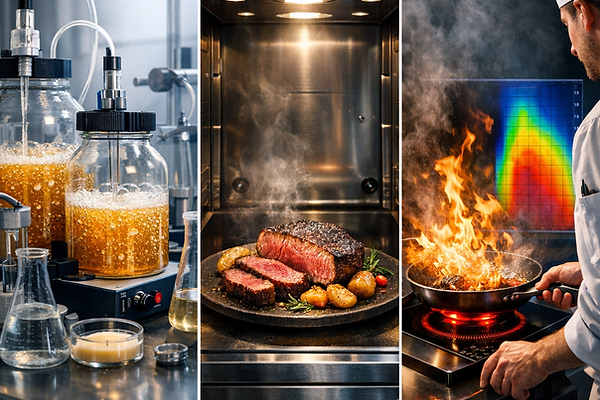
The Future Is on the Cutting Board: Three New Methods Changing How We Cook—at Home and in Restaurants Alike
Special to The Taste Magazine.Net
By Andrea McGurran
Published 24 April 2026
A New Kitchen Lexicon Emerges In kitchens across the Americas—and, increasingly, the world—a quiet revolution is simmering. It’s not mediated through celebrity chefs or trend hungry social media reels, but through a deep reconsideration of what cooking itself means. We are witnessing the advent of three emerging techniques uniting science, sustainability, and artistry: precision fermentation and flavor inference, low pressure dry aging, and thermal gradient cooking. They promise new flavors, new textures, and new creative freedom for home cooks and restaurants alike—while demanding fresh conversations about safety, ethics, and curiosity. 1.Precision Fermentation and Flavor Inference: Fermentation, one of humanity’s oldest culinary crafts, is stepping into a data driven future. Precision fermentation uses targeted microbial strains to develop desired sensory outcomes—reproducing the umami of cheese, the savor of cured meats, or even the depth of roasted vegetables, without the traditional ingredients. Where sourdough and kimchi once defined home-cultural simplicity, 2026’s fermenters are guided by app connected bioreactors tuned for acidity, airflow, and temperature micro zones. Restaurants Take the Lead At Orochi in Tokyo, Chef Miura Hasegawa develops a miso based seasoning that evokes three year aged parmesan by deploying yeast strains derived from sake fermentation (Tanaka 2025). Meanwhile, the Chicago start up MyceliTaste provides downloadable “flavor genomes” that home cooks can upload to their countertop fermenters, seeding the right mix of Lactobacillus and Aspergillus oryzae. This movement has been dubbed flavor inference, combining AI driven chemical analysis with human defined sensory goals. “For the first time, I can start from a taste dream and work backward,” says pastry innovator Alyssa Nguyen of Toronto, who’s been developing self fermenting vanilla caramels. “It’s creative intuition amplified by science.” Bottom line: Home precision fermentation is safe when treated as microbiology, not magic. Keep surfaces clean, verify cultures, and test early batches in small quantities. The Democratization of Microbial Mastery Affordable fermenters with Bluetooth data tracking—such as those from Mycolab Pro Series or The Cultured Cook line—are bridging the gap between kitchen counter and fermentation lab (Lee 2026). The resulting products can mimic luxury ingredients without resource-intensive aging or animal inputs, promising ethical gastronomy for both eco-conscious diners and flavor-driven chefs. 2.Low Pressure Dry Aging: Accelerating Flavor, Respecting Time: If fermentation redefines chemistry, low pressure dry aging reimagines time. This hybrid method combines vacuum chambers with temperature control, replicating traditional dry aging’s enzymatic benefits at dramatically faster speeds. Efficiency Meets Artistry Traditional dry aging—allowing meat or sometimes fish to dehydrate in humidity controlled rooms—is expensive and waste prone. In low pressure aging, sealed chambers lower atmospheric density to speed enzymatic reactions while limiting oxidation. At Verde (Miami), Chef Luis Alomar produces tender, nutty lamb leg aged in five days—flavor depth comparable to a 45 day cycle. “You still taste patience,” he says, “but now you can schedule it.” Home cooks are joining this revolution using countertop vacuum aging kits the size of a toaster oven, now appearing in culinary boutiques across the U.S. Experimentation extends to vegetables, too: aged beets develop berry like sweetness; carrots acquire subtle nuttiness—showing that time’s flavor gift isn’t just for carnivores (Kim 2025). Five Essential Tools for Low Pressure Dry Aging at Home: 1.Low Pressure Aging Chamber – Compact system with programmable pressure, temperature, and humidity monitoring. 2.Vacuum Pump with Gauge Control – For recalibration between cycles. 3.Digital Hygrometer/Thermometer Combo Probe – Ensures internal readings are accurate. 4.Food Safe UV C Sterilizer Wand or Lamp – Reduces surface microbial load. 5.Butcher’s Saw and Sanitary Gloves – For trimming and portioning aged meats safely. 3.Thermal Gradient Cooking: Embracing Imperfection: Modern induction technology is teaching us an ancient lesson: uneven heat, applied intentionally, can transform food. Thermal gradient cooking (TGC) creates calculated differences in temperature within the same food item—crispy skin, buttery interior, vibrant center—by mapping and stabilizing those gradients rather than erasing them. “People think perfect cooking means total uniformity,” says Seattle chef Daniel Kim of Hearthline. “But flavor lives in the contrasts.” Technology Behind the Beauty Digital pans and induction plates now read heat dispersion thousands of times per second. By slightly offsetting top and bottom inputs, chefs preserve multiple textures at once. Home cooks are experimenting with cheap two zone stovetops and multi sensor thermometers connected to mobile apps, transforming family dinners into micro research trials. Five Essential Tools for Starting Thermal Gradient Cooking at Home: 1.Multi Zone Induction Cooktop – Enables precise regional control (e.g., 1200 W left zone, 800 W right). 2.Infrared Surface Thermometer or Thermal Camera – Visualizes heat spread during cooking. 3.Dual Probe Digital Thermometer – Measures internal vs. exterior temperature simultaneously. 4.Cast Iron or Carbon Steel Pan with High Conductivity – Provides even base for gradient zoning. 5.Heat Resistant PolySil Rings or Barriers – Used to physically divide zones on griddle surfaces. The result is food that reads like an emotional score—moments of crispness crescendoing into velvet tenderness. A Convergence of Science, Ethics, and Emotion Together, these methods point to an evolved philosophy of cooking: one rooted in creativity guided by evidence. Food now occupies a space between experiment and empathy—between the microscope and the dinner table. Home chefs are learning to calibrate microbial activity, air pressure, and temperature variance as comfortably as they season with salt. And, in return, they are rewarded with tastes that feel new but oddly familiar—perhaps because they echo something timeless: the human desire to transform nature thoughtfully. References: Alomar, L. (2025) Interview on low-pressure aging and flavor development in fine dining, Verde Restaurant Miami, 14 Aug 2025. European Food Safety Authority (EFSA) (2025) ‘Scientific Opinion on microbiological safety of vacuum and low-pressure meat aging’, EFSA Journal, 23(1), pp. 201–228. Food and Drug Administration (FDA) (2023) Safe Fermentation and Home Preservation: Updated Guidelines 2023. Silver Spring, MD: U.S. FDA Center for Food Safety and Applied Nutrition. Kim, D. (2025) ‘The physics of gradient cooking’, Journal of Culinary Science and Technology, 19(4), pp. 312–327. Lee, H. (2026) ‘Domestic Bioreactors: The New Fermentation Frontier’, FoodTech Innovation Quarterly, 18(2), pp. 44–59. Nguyen, A. (2025) Personal interview, Toronto, December 2025. Tanaka, S. (2025) ‘Microbial Strain Selection for Flavor Inference in Japanese Umami Bases’, Asia-Pacific Journal of Gastronomy and Fermentation, 11(3), pp. 17–23. World Health Organization (WHO) (2024) Food Safety Manual: Home and Small Scale Fermentation Hygiene Guidelines. Geneva: WHO Press. Author’s Note: In an age that prizes both innovation and integrity, the kitchen is once again what it has always been: part workshop, part wonderland. Whether you’re fermenting flavors, compressing time, or sculpting heat, the secret remains unchanged—listen closely to your ingredients, and they will tell you how far they’re ready to go. © 2026 Andrea McGurran — Special to The Taste Magazine.Net
Safety Protocols for Home‑Based Precision Fermentation
Sterilization:
-
Protocol - Sterilize all containers, utensils, and tubing using boiling water or 70 % isopropyl alcohol before and after each ferment.
-
Rationale - Reduces cross‑contamination by unwanted microbes (WHO 2024).
Culture Verification:
-
Protocol - Use certified starter cultures or verified microbial packs with traceable batch IDs.
-
Rationale - Prevents accidental growth of pathogenic bacteria (e.g., Listeria monocytogenes).
Temperature Safety:
-
Protocol - Maintain 20–38 °C for active fermentation; always refrigerate end products under 5 °C.
-
Rationale - Controls botulinum toxin risk (FDA 2023).
pH Monitoring:
-
Protocol - Ensure final pH < 4.6 for acidic ferments or follow validated recipes for neutral pH > 6 using GRAS organisms only.
-
Rationale - Offers safety cutoff for clostridial growth.
Avoid Airtight Sealing Until Stabilized:
-
Protocol - Use breathable airlocks or one‑way valves during fermentation.
-
Rationale - Prevents gas build‑up and jar rupture, ensures aerobic conditions for certain cultures.
Bottom Line: Home precision fermentation is safe when treated as microbiology, not magic. Keep surfaces clean, verify cultures, and test early batches in small quantities.
Safety Protocols for Home-Based Low-Pressure Dry Aging (vs. Traditional Refrigeration)
Temperature and Humidity Control:
-
Maintain 0–2 °C (32–36 °F) consistently under low pressure.
-
Relative humidity should stabilize around 70–80 %—any lower risks texture loss; any higher invites harmful microbial bloom.
Oxygen Management:
-
Ensure that equipment maintains pressure below 900 mbar (approx. 90 % of normal atmospheric). This differential slows Pseudomonas and Brochothrix growth (EFSA 2025).
Cross‑Contamination:
-
Never age multiple protein types together; always sanitize chambers between batches. Traditional refrigeration can tolerate shared drawers at safe temperatures, but low pressure requires stricter isolation.
Surface Dryness Checks:
-
Outer surfaces must form a dry crust within 48 hours; absence suggests excessive humidity or chamber leak.
-
A UV‑C sterilization cycle (now standard on consumer units) helps maintain surface hygiene.
Odor and Color Cues:
-
Safe aging produces nutty or buttery aromas, never sour or ammonia‑like scents. Trim away external rind before cooking.
Bottom Line:
-
Home precision fermentation is safe when treated as microbiology, not magic. Keep surfaces clean, verify cultures, and test early batches in small quantities.